
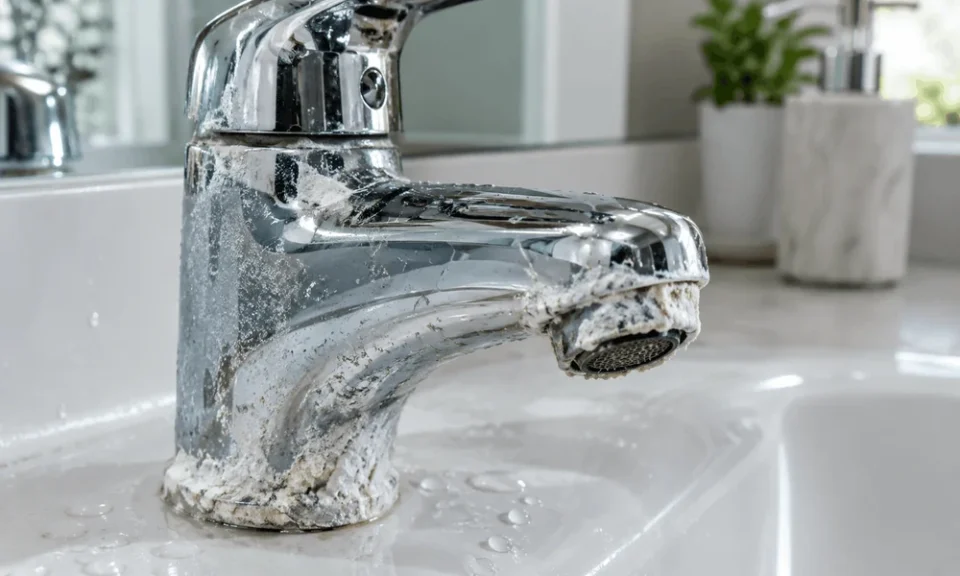
Run a fingernail along the base of your kitchen tap and you may feel it, a rough little ridge of white that returns days after you scrub it away. Plenty of Mesa homeowners reach that moment and start looking into Mesa water softeners, and the licensed crew at Plumb Crazy Plumbing and Drains, who have spent over twenty years working across the Phoenix metro, install and service them for homes and businesses around the Valley. Before anyone buys a tank, though, it helps to understand what that crust actually is, because the answer shapes every choice that follows.
Rocks that dissolved on the way to your tap
Water in this part of Arizona comes from rivers, canals and groundwater that move through mineral rich ground for a long way. Along the trip it picks up calcium and magnesium, the two minerals that define hardness. They are harmless to drink, but when water is heated or dries on a surface, they come out of solution and harden into scale.
Hardness is usually measured in grains per gallon, and one grain is roughly 17 parts per million. Numbers quoted for the Valley vary quite a bit depending on who tests and where, so the most useful figure is your own. A test strip costs a few dollars, and a plumber can run a proper test in minutes.
Small clues around the house
You rarely need a lab to suspect hard water. These are the common giveaways.
- Spots on glasses that survive the dishwasher
- A film on shower doors that returns within a week
- Soap that refuses to lather and hair that feels coated
- Towels that dry stiff, with colors fading early
- Showerheads that spray sideways
Behind the walls the same minerals narrow pipes a little more each year, and inside a water heater they settle on the bottom and around the heating element. A heater that takes longer to warm up or rumbles while heating is often telling you about scale, not age.
What actually happens inside the tank
A softener works by trading one mineral for another, a process called ion exchange. The tank holds a bed of tiny resin beads that start out coated with sodium. As hard water passes through, calcium and magnesium cling to the beads more strongly than sodium does, so they stay behind while a little sodium goes into the water.
Eventually the beads fill up, and the system has to clean itself. That cycle, called regeneration, happens in four short stages.
- Water flows backward through the tank to loosen sediment.
- Salty brine from the second tank washes over the resin and pulls the captured minerals loose.
- A fast rinse carries the brine and minerals down the drain.
- The resin is recharged and normal service resumes.
This is why you keep a bag of salt nearby. The salt is not going into your water in any meaningful amount. It is the cleaning agent that keeps the resin working.
Salt or no salt, an honest comparison
Salt free systems get marketed as a gentler alternative, and they do have a place. They do not remove calcium and magnesium. Instead they change how those minerals behave so they cling less to surfaces. That can help with pipe and fixture buildup, and there is no brine to drain and no salt to haul.
What they will not do is soften the water in the way people usually expect. Soap will not lather as richly, and spots on glassware may still appear. If your goal is truly softer water, a salt based unit is the one that delivers it. If your goal is mostly lighter scale with minimal upkeep, a conditioner can be a reasonable compromise.
Sizing, the part buyers underestimate
A softener that is too small has to regenerate constantly, wasting salt and water while still struggling to keep up. A softener that is too large costs more than it needs to. The right size comes from three things, how many people live in the house, how much water they use, and how hard the water is.
Control valves matter too. Timer based valves regenerate on a fixed schedule whether or not the resin needs it. Metered valves track actual use and regenerate only when necessary, which generally saves salt and water. For households with changing schedules, a metered valve is usually the smarter pick.
Where it goes and what it should skip
Installation location matters more than most people expect. A softener belongs on the line that feeds the house, ahead of the water heater so the heater benefits too. Outdoor taps are usually left on hard water, since there is no reason to soften what you spray on a lawn or use to rinse the driveway. A bypass valve lets you shut the unit out of the loop for maintenance.
Some communities and homeowner associations have rules about where regeneration water may drain, so a quick call to your city or HOA before installing is worth the minute.
The drinking water question
Many people worry that softened water tastes salty or adds too much sodium. A properly set softener adds only a small amount, and most households never notice the difference. If you want the best tasting water for drinking and cooking, a small reverse osmosis system at the kitchen sink is the usual companion. It handles drinking water while the softener protects everything else.
Keeping it healthy for a decade or more
Good softeners can last somewhere between ten and fifteen years with sensible care, and the care is not demanding.
Check the brine tank about once a month and keep it stocked. Occasionally the salt forms a hard crust, called a bridge, that leaves an empty gap underneath, so poke the top with a broom handle to make sure it is loose. Notice how often you refill, because a sudden change in salt use is a clue that something is off.
If water that used to feel soft suddenly turns hard, the usual causes are an empty brine tank, incorrect settings, or tired resin. Chlorine in municipal water slowly wears resin down over the years, which is a big reason units eventually need rebedding or replacement.
One honest caveat is worth passing along. A new softener will not instantly dissolve the scale that has been building for years. It stops new buildup, and with time, existing deposits tend to loosen, but heavily crusted fixtures may still need replacing.
Questions worth asking before you sign anything
A good installer should be glad to answer these.
- What is my actual hardness reading, and how was it measured?
- How was the unit sized for my household?
- Does the valve regenerate on a timer or by metered use?
- Where will it be installed, and is there a bypass?
- What does yearly upkeep involve, and what does it cost?
- Is the equipment tested to recognized industry standards?
For that last point, the NSF/ANSI 44 standard for residential water softeners sets the bar for softening capacity, brine system accuracy and material safety, so ask whether the unit you are being quoted is certified to it. Compare more than one quote and ask for everything in writing.
